
Finding Anderson Township Resident Records
The right record depends on what you already know about an Anderson Township address. An owner name points to the county property roll. An old street address leads to deeds or library directories. For a registration question, the official election route covers the named person. The Anderson Township residents directory works as a path through county and library records. It is not one roster. Match each question to its source. Find who lives on a street in Anderson Township by comparing ownership, a directory listing, and current residence as separate facts.
- Search the Auditor by owner name, exact address, or a short street range and save the parcel number.
- Use the parcel number, legal description, transfer date, or recorded party name in the Recorder index.
- For a named registration question, use the official Ohio voter route and contact the Board of Elections for a nonmatch.
- For a past household, compare a dated directory entry with census, obituary, or probate context.
- When the relevant Township record is offline, make a focused Ohio Public Records Act request to its custodian.
Anderson Township Resident Record Custodians
County offices hold the core land and court records for Anderson Township. The Township keeps administrative files, Planning & Zoning, Fire & Rescue, Public Works, and other address-linked material. It is not the deed or parcel custodian. Go to the office that creates the record. That simple rule keeps an ownership trail and a court file in order. It keeps an election question and a Township request each in their proper lane.
Hamilton County Recorder
Recorded deeds, plats, liens, and historic document series
County counter and historic-record access
Ask the office for current copy and certification options.
Hamilton County Auditor
Parcel, ownership, transfer, assessment, and tax-district records
Property Search and counter clarification
513-946-4000
Hamilton County Board of Elections
4700 Smith Road, Cincinnati, OH 45212
Registration, precinct, and inspection questions
513-946-8500
When a named legal event is the question, the Hamilton County Clerk of Courts and Probate Court add case, estate, marriage, and other court channels. Their files can identify a party or a dated filing. They do not establish where a person lives now.
Anderson Township Parcel Search Basics
For an Anderson Township property question, the Hamilton County Auditor Property Search is the strongest first stop. It takes an owner or organization name, street address, parcel number, sales search, and advanced criteria. Owner searches work best with the legal name format from transfer documents, last name first. Partial entries are allowed. A common name or a long road can return a big set. Results stop at the first 1,000, so narrow the search when needed.
| Auditor field | Type | When to use it | Format or limit |
|---|---|---|---|
| Owner/Organization/Other Name | Text | Find a legal owner or organization | Last name then first name; partial terms work |
| House # Exact/Low | Text or number | One address or low range end | Leave High blank for one address |
| House # High | Text or number | Search a street segment | Optional range endpoint |
| Street Name | Text | Address and range searches | Use the base name, without a suffix |
| Parcel Number | Text | Open one known property | Most county parcels use 13 characters; partial entry is accepted |
| Transfer Date Low/High | Date range | Narrow a sale or transfer trail | Pair with owner, parcel, or address facts |
Write down the situs address, parcel number, property key, and short legal description. Also note the transfer book and page, transfer date, and tax or school district for the matching parcel. These facts bridge a deed search and a historical map. For a full address-by-address method, the Anderson Township street directory keeps the focus on range searches. It also covers legal parcel links.
Check the Hamilton County Auditor Property Search source before using the tool.
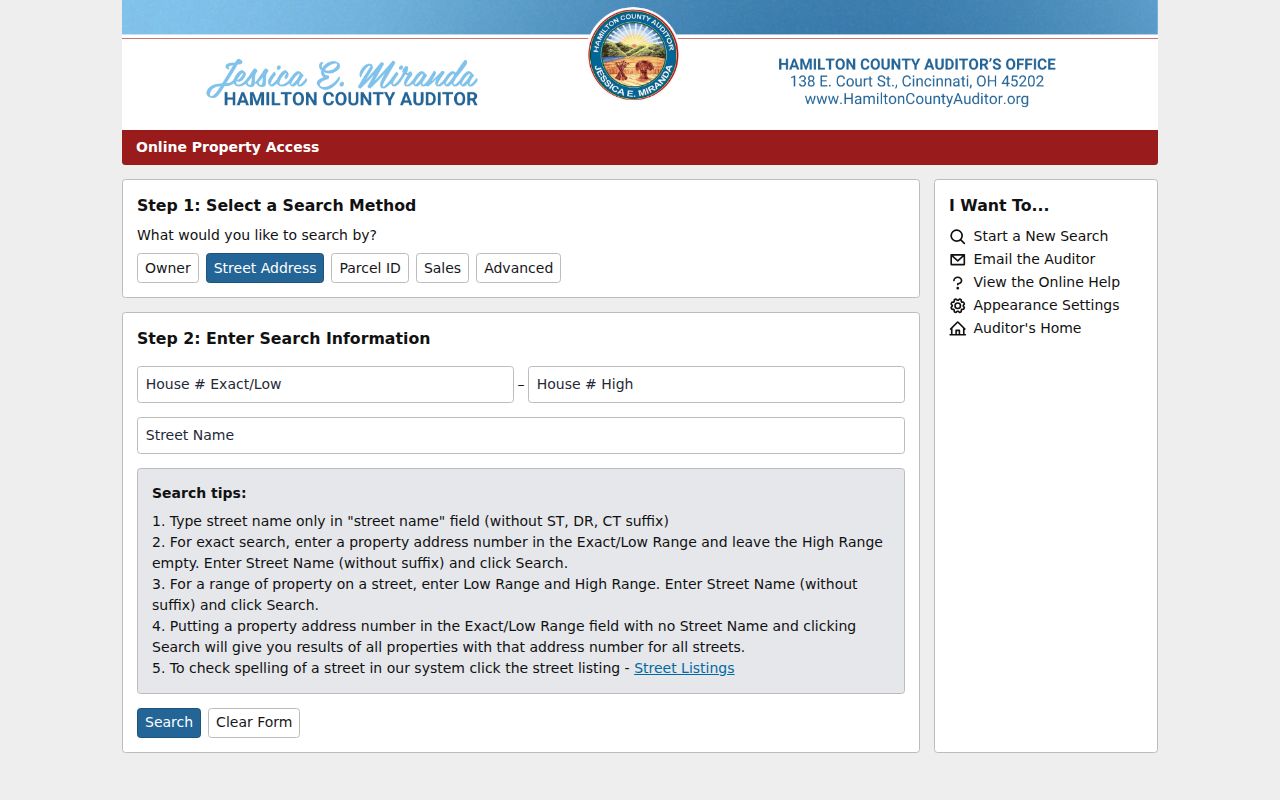
The Auditor screen starts a parcel trail. It is not a directory of every current household member.
Anderson Township Deeds Through Acclaim
Acclaim is the Hamilton County Recorder's public-document index. It offers separate routes for name, record date, date range and document type, book and page, document number, subdivision and lot, section, town, and range, Auditor number, subdivision name, and certificate number. The Auditor number shines after an address search. Acclaim carries a current parcel clue into recorded deeds, plats, liens, and dated party relationships.
An index entry is not the certified document itself. A spelling, legal description, or document character may matter. In those cases, confirm it against the image, counter record, or certification route. CHPL notes that the Recorder's historic records include deeds from 1789 to present. Named historic books and indexes begin in 1794. Availability varies by series. One online miss does not define the whole historical record.
Open the Hamilton County Recorder Acclaim source for the current query choices.
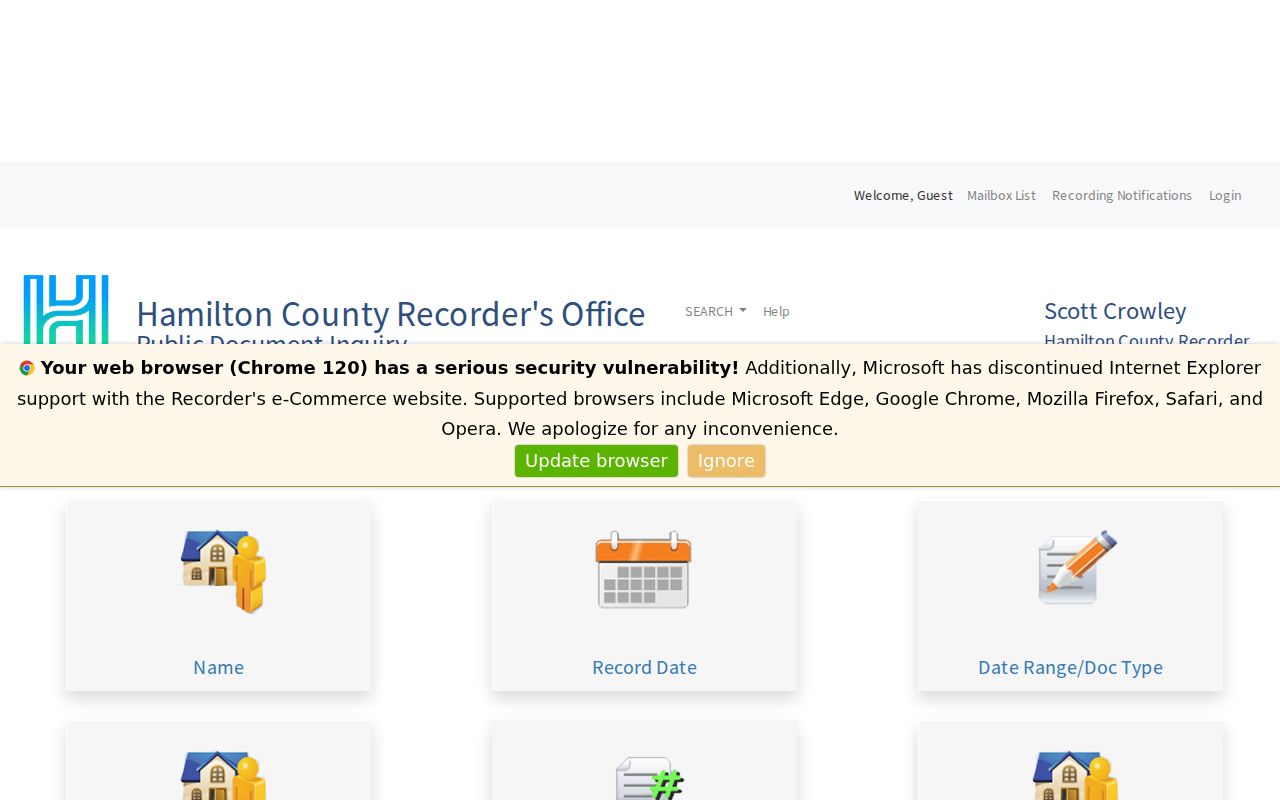
The Recorder's separate search paths explain why a parcel, legal description, or document number beats a modern address alone. Each path answers a different record question.
Note: Acclaim became the Recorder's public query in 2025, and its display details can change, so confirm against the live record or office counter.
Anderson Township Voter Record Limits
The Ohio Secretary of State Voter Toolkit works for a specific person. It uses first name, last name, and county. It can answer a named registration or precinct question. This holds under the fields, exclusions, and current conditions of the official system. It is not a browse-by-street resident roll. Registration never reveals ballot choices. Ohio does not register voters by party. Primary participation must not be recast as party registration.
The Toolkit may not resolve a spelling, former name, or precinct question. The Hamilton County Board of Elections then serves as the county access channel. Public voter-file access carries statutory limits under ORC 3503.13 and ORC 3503.153. Protected records and Safe at Home participants belong with the custodian, not a workaround.
Use the Hamilton County Clerk records-search source when a dated court filing helps. It can separate people with the same name.
A court search only names a party to a case. That result can confirm someone appeared in a specific proceeding, but it cannot stand in for an address record or a registration record when the question is where a person lives.
Current Anderson Township Resident Sources
Current resident records for Anderson Township sit in separate systems. Each was built for its own purpose. The property roll names a legal owner or organization tied to a parcel. The Recorder index lists parties to recorded instruments. Voter records answer a registration question about a named person. Court and probate files identify parties to particular proceedings. A chamber listing is voluntary. So it can describe a participating organization but never serves as an official or complete resident roll for Anderson Township.
| Source | What it can show | Keeper | Access boundary |
|---|---|---|---|
| Property roll | Legal owner, situs parcel, transfer and assessment clues | Hamilton County Auditor | Free portal; owner or mailing field is not residency proof |
| Recorded document index | Parties, record date, instrument and legal-description links | Hamilton County Recorder | Free index; image or certification varies |
| Voter lookup | A named voter’s registration and precinct facts | Ohio Secretary of State and Board of Elections | Individual official route with statutory exclusions |
| Court and probate indexes | Case party, decedent, heir, marriage, or docket context | Hamilton County courts | Protected and sealed material remains unavailable |
| Chamber directory | Voluntary member-business and community contacts | Anderson Area Chamber | Not a resident list and not comprehensive |
Every current record answers one narrow question. Keep it that way. When the same name shows up in more than one source, compare details before assuming the entries describe one person. A legal description, a date, a case number, a role, or a directory year can separate two people who share a name. Those small details work well. The Anderson Area Chamber is a good voluntary contact point for participating organizations. County custodians remain the true record sources for parcels, deeds, registration questions, and court files.
Anderson Township Address Types Differ
One Anderson Township property can carry several addresses and identifiers at once. The situs address locates the parcel itself. An owner mailing address, where tax correspondence goes, may sit somewhere else entirely. The legal description tracks a lot, subdivision, block, or township-range reference through deeds and plats. Postal city, ZIP code, tax district, and school district help with navigation. None of them, on their own, establishes township jurisdiction. None of them identifies who lives at the site.
- Parcel
- A tax and property unit identified by the Auditor, often the strongest link between an address and land records.
- Index
- A searchable guide to records, rather than the certified record itself.
- Resident roll
- A source that lists people for a stated public purpose and date, never a complete household census.
- Criss-Cross directory
- An address-first historical directory that helps locate printed listings along a street.
Postal routes and local government lines do not always match in Anderson Township. ZIP codes 45230, 45244, and 45255 all serve the area. A single delivery address can sit inside a different boundary than its ZIP suggests. Confirm the exact address with USPS first. Then check parcel and map records to pin down which jurisdiction applies.
For birth and death certificates, see the Hamilton County Public Health source. That office handles the local records channel.
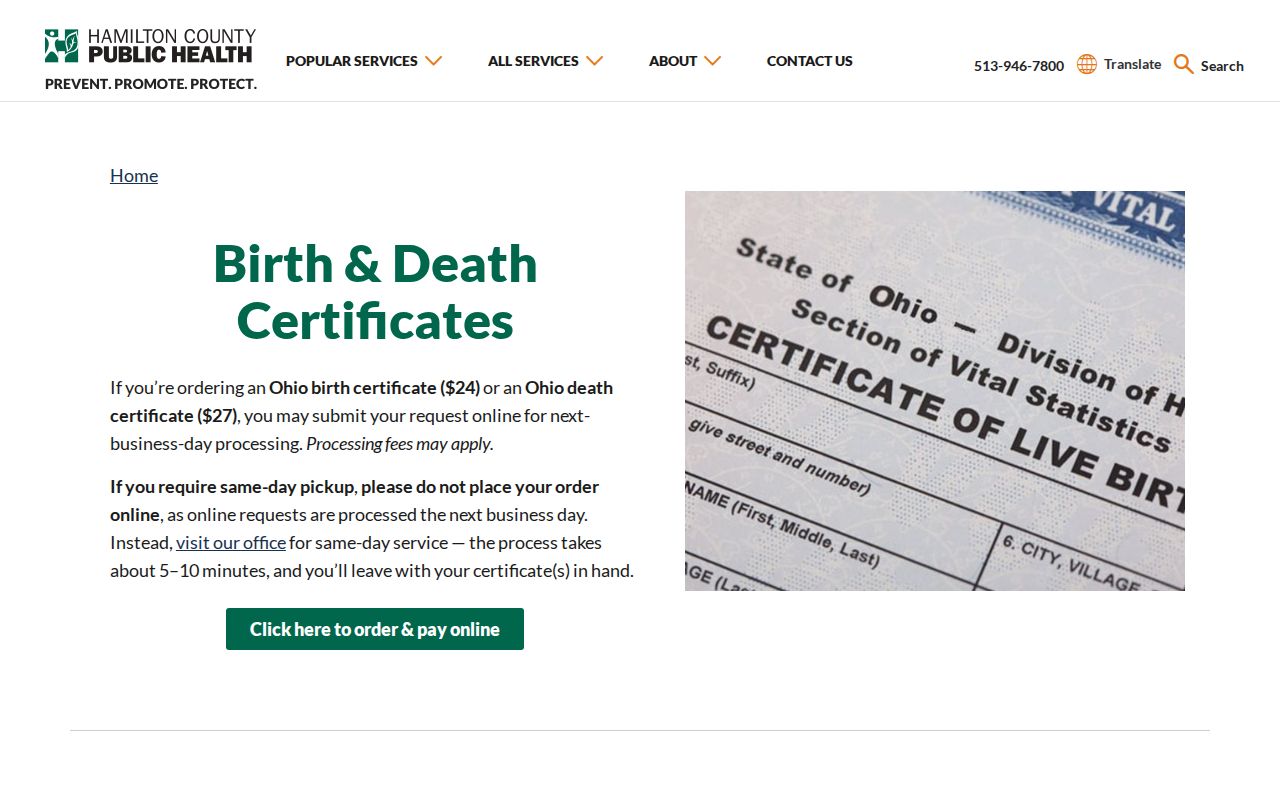
Vital records follow their own certified-copy process and are not a free current-resident search.
Anderson Township Offline Record Requests
Some Anderson Township records never reach the web. Planning & Zoning, Fire & Rescue, Public Works, and administrative files often stay offline. These often require a direct request. Describe the exact address, record category, and date range. Say whether inspection or copies are wanted. The Township request form offers inspection, copy, and delivery choices. Its stated charge is five cents for an 8.5 by 11 inch copy, with at-cost oversize, mailing, and prepayment conditions where applicable. Ohio's Public Records Act, ORC 149.43, governs public offices. A requester does not have to give a name or explain the intended use. Offices should prepare records for inspection promptly, or within a reasonable period. Ordinary inspection generally carries no charge. The law still protects certain addresses, sealed court records, medical information, and other exemptions. Before preparing a focused request, view the Anderson Township public-records request form source.
The Township itself is the fallback for its own records. For land records, the county remains the main path.
Historic Anderson Township Household Listings
Older Anderson Township households start with the Hamilton County directory collection. It sits at Cincinnati and Hamilton County Public Library. The Cincinnati collection matters too. Regional publishing and postal place names often blur the lines. Its City Directories are searchable back to 1819. CHPL points to Hamilton County directories as the natural route for homes, buildings, prior residents' names, occupations, and spouses. Check exact volume coverage in the live collection before trusting any single year. Address-first searching gets easier with the Pink Pages. They began in 1925 and carried the Criss-Cross Directory name by 1941. These volumes list addresses in street order. A printed occupant or owner listing can appear for a particular year. It shows neither legal title nor every household member. When an online county index hits a gap, CHPL also provides census records, newspapers, maps, and free genealogy staff appointments. For the library access route, view the CHPL Genealogy and Local History source.
Library staff and in-library collections offer a documented route for historical household work. When a modern portal cannot reach an older record, they often can.
Anderson Township Began in 1793
Anderson Township was Hamilton County's fifth township, founded in 1793. It once stretched into what is now Clermont County. Later annexations and boundary shifts still shape how an old address should be searched. A current Cincinnati mailing label, subdivision name, or street reference may not match the jurisdiction that held an earlier record. Before carrying present boundaries backward, check the dated map, parcel, legal description, and jurisdiction. This history also explains why subdivision and lot information can outlast a familiar street number. The Township's official map shows boundaries, streets, ZIP areas, facilities, and a subdivision index. A record trail may cross older rural land, later subdivisions, and adjoining municipal areas. In that case a plat or legal description is often the steadier point of comparison. The official history describes settlement near the Little Miami River. Growth later centered on Forestville, Sweetwine, Fruit Hill, and Cherry Grove. A rural area gave way to postwar subdivisions. That growth was shaped in part by the Beechmont Levee, I-275, and I-471. An older document may use township land language, but a later record leans on a subdivision and parcel. That shift explains the difference. Record the source date first. Only then match either form to a modern street address.
Anderson Township Source Comparison
Two kinds of sources answer two different questions. An official residents directory custodian, such as a recorder or assessor, can tell you where a record came from. The same office can tell you when it dates from and how to fix an error. A commercial people-search site blends fragments from many places. The sourcing behind any entry may be fuzzy. For a parcel, deed, or court question in Anderson Township, trust the official index. Then call the named office when a detail has to be certified.
| Official source | Commercial category | Practical difference |
|---|---|---|
| Auditor or Recorder record | Compiled profile | County identifiers and a custodian can be checked against the source record. |
| Voter or court route | Mixed public and private data | Official access has defined limits, while a profile may not show its date or origin. |
| CHPL directory volume | Undated address claim | A volume year and page can be recorded instead of assuming present residence. |
Anderson Township Record Dates Matter
Record coverage in Anderson Township varies office to office. The Public Library of Cincinnati describes Recorder deeds from 1789 forward. Historic deed books there start in 1794. Its house-history workflow points to Auditor material from 1937 on. Earlier deed work goes back to the Recorder. One historic grantor and grantee index covers 1914 through 1988. So the route depends on the record and the year. No single portal shows everything.
When a modern index runs out, work the alternatives in order. Try the named historic book or index first. Then try the Recorder or court counter. A focused public-record request comes next. The library, an archive, or a historical group can add context after that. Hamilton County courthouse fires in 1813, 1849, and 1884 destroyed some records outright. A gap may call for reconstructed indexes, deed books, tax duplicates, newspaper notices, or archival copies. Don't conclude that nothing ever existed.
CHPL earns its spot in that sequence as the library fallback. Its Genealogy and Local History service offers staff help with city directory research. The House History route bundles directories, census, maps, newspapers, and recorded-land material in one place. All 41 CHPL branches became FamilySearch Affiliate Libraries in 2025. That adds image access for a signed-in user on a library computer or over library Wi-Fi. Still, the library gives support and context. The Recorder, Auditor, and courts certify their own records in Hamilton County.
For one narrow purpose, the Ohio DRC Offender Search source shows state-custody status. It is not a tool for building a resident lookup.
State custody tools serve one narrow official purpose. They are no substitute for a Hamilton County residents directory built from property rolls, voter rolls, and recorded deeds.