
Anderson Township Neighbors by Parcel
For the block around one Anderson Township address, public records supply a parcel-and-document trail. The Auditor establishes the target parcel, its owner or organization, property key, and legal description. CAGIS can provide map context when its live application works. The Recorder identifies recorded deeds and plats. CHPL address directories and census sources are historical, dated evidence. None of these sources creates a complete current neighbor roster.
| Source | What It Shows About a Block | Access |
|---|---|---|
| Auditor and CAGIS | Parcel geometry, property identifiers, and owner or organization clues | Public property portal and map entry point |
| Auditor distance search | Nearby parcels from an origin property key | Advanced property search |
| Recorder and plats | Lots, subdivision, deed chain, and legal continuity | Acclaim, historic sources, or counter |
| CHPL Criss-Cross | Historical addresses in street order and printed listings | Library or digital collection |
| Community referrals | Voluntary public contacts or local-history assistance | Chamber and Historical Society |
Owner and mailing information are not proof of occupancy. Renters, partners, children, adult household members, utility customers, delivery recipients, and protected participants are not converted into a public block list.
Map Anderson Township Neighbor Parcels
The verified method starts with an exact property, then compares individual parcels. Search the Hamilton County Auditor Property Search by address and record the parcel number and property key. Open CAGIS with those clues if it is available. The map application returned a gateway error during research, so no undocumented layer, buffer, or button is claimed here. If it loads, identify surrounding parcels one at a time and verify them in the Auditor.
- Find the target parcel and retain its parcel number, property key, legal description, and retrieval date.
- Check adjoining parcel shapes in live CAGIS if its current controls are available.
- Open each matched parcel in the Auditor and keep recorded owner or organization evidence separate from residency.
- If CAGIS fails, use Origin Property Key and Feet from Origin, then compare the returned addresses parcel by parcel.
The property-key distance tool is a fallback, not a block map. A radius can reach across a street, cul-de-sac, or noncontiguous land. For a full named-street chain, use the Anderson Township street directory.
Anderson Township Radius Limits
The Auditor’s Advanced Search supports Origin Property Key and Feet from Origin. That is a useful local, documented way to locate nearby parcels after a target property key is known. It also has a 1,000-result limit. A radius does not prove which parcels share a block, and it cannot supply a household list. Compare parcel geometry, street frontage, and legal subdivision information before using the word adjacent.
Recorder plats offer a better legal bridge. Acclaim can be searched by Auditor number, subdivision and lot, section/town/range, document number, book/page, name, or date. The parcel number and legal description connect the Auditor record to deed and plat material, which is more dependable than a visual guess from a radius.
Anderson Township Subdivision Context
The official Township map includes a substantial subdivision index, with names such as Anderson Commons, Anderson Forest, Coldstream Park, Ivy Hills, Turpin Hills, Watch Hill, and Woods of Anderson. A subdivision name can help locate a plat and explain the lot language in a Recorder record. It is not proof that a homeowners association exists or that it publishes member information. No authoritative inventory of active Township associations, joining rules, or resident-directory policies was located.
The Township was founded in 1793 and later boundary changes shaped today’s records geography. Use a dated map or plat for a historic block, especially near Cincinnati, Newtown, or an annexation boundary. Present parcel lines should not automatically be projected onto an older street.
Historic Anderson Township Neighbors
For an earlier block, use the same year’s Pink Pages or Criss-Cross address directory, then pair it with the census and an appropriate map. CHPL reports that Pink Pages began in 1925 and were called Criss-Cross by 1941. They list addresses in street order, making them better for a historical block than an alphabetical directory. A listed name applies to that volume’s date and coverage, not to a current household or a title claim.
When a deed chain shows a transfer interval, select directory and census years inside that interval. Check the legal description and any plat before assuming an old street number matches a modern parcel. Cincinnati’s documented 1895 number change is a warning for city research, not a blanket Anderson Township rule.
CHPL’s house-history route brings together directories, census, maps, newspapers, photos, and a free genealogy-staff appointment when the online parcel trail ends. The library’s Cincinnati directories reach 1819, while federal census material is available through 1950. Those resources are complementary: the Recorder supplies recorded land evidence, the Auditor supplies the current property connection, and the library supplies dated household context. Record the volume year, map date, and source citation before comparing historical neighbors across the block.
Anderson Township Community Referrals
Community resources can offer context and a contact path, but they are not membership rosters. The Anderson Area Chamber directory is voluntary business and community information serving Anderson Township, Mount Washington, Newtown, and western Clermont. The Anderson Township Historical Society accepts local genealogy, newspaper, and history research inquiries by appointment. Ask for public contact information or historical assistance, not a list of neighbors or private members.
| Community resource | Public contact purpose |
|---|---|
| Anderson Area Chamber | Voluntary organization and community contacts, not a resident roll. |
| Anderson Township Historical Society | Appointment-based local history and genealogy referral. |
| Anderson History Room | Township and Historical Society local-history interpretation. |
These sources support neighborhood history and referrals. They do not establish who belongs to an association or who resides on a block.
Anderson Township Neighbor Source Comparison
Official sources state their custodian and record purpose. They can be checked again at the Auditor, Recorder, court, library, or Township office. Unnamed commercial neighbor tools often combine fragments from different dates and sources, leaving the reader unable to tell whether a name refers to an owner, former occupant, or another person. An official record is still limited, but its date, office, and correction route are visible.
| Official record route | Unverified commercial category |
|---|---|
| Shows the parcel, document, case, or historical volume that supports a specific fact. | May blend stale or ambiguous fragments without a clear custodian. |
| Has a counter, copy, correction, or records-request path. | May not show how a result was matched or updated. |
| Requires source-specific limits to be respected. | Cannot turn a name result into proof of residency. |
Anderson Township Voter Privacy
Ohio’s voter lookup and county registration tools are for a specific named person, not a method for compiling neighbors. ORC 3503.13 governs public registration lists and limits uses, while protected voter information and Safe at Home participants are excluded. The state lookup can help confirm a named registration or precinct only through its official process. It does not reveal ballot choices, and primary participation does not establish party registration.
Safe at Home uses a substitute address for eligible participants. If a source is redacted or unavailable, do not attempt to reconstruct a protected address from other records. Ohio also permits online public-record redaction of enumerated personal information through the ORC 149.45 process. A redaction request is not a way to erase every public record, but it gives a person a route to the custodian when qualifying information appears online. Keep a parcel result, a court index, and a historical directory in their separate contexts.
Anderson Township Neighbor Safety Requests
Public-safety information has narrow roles. Current custody information can change quickly, and a no-result does not establish a person’s status. Use the Sheriff’s published contact or request route for an incident report, and independently verify any message that cites a case number, warrant, court, or public record. Do not rely on a caller’s link or pressure to pay.
Neighbors - Hamilton County inmate search shows the Sheriff’s current-custody search route.
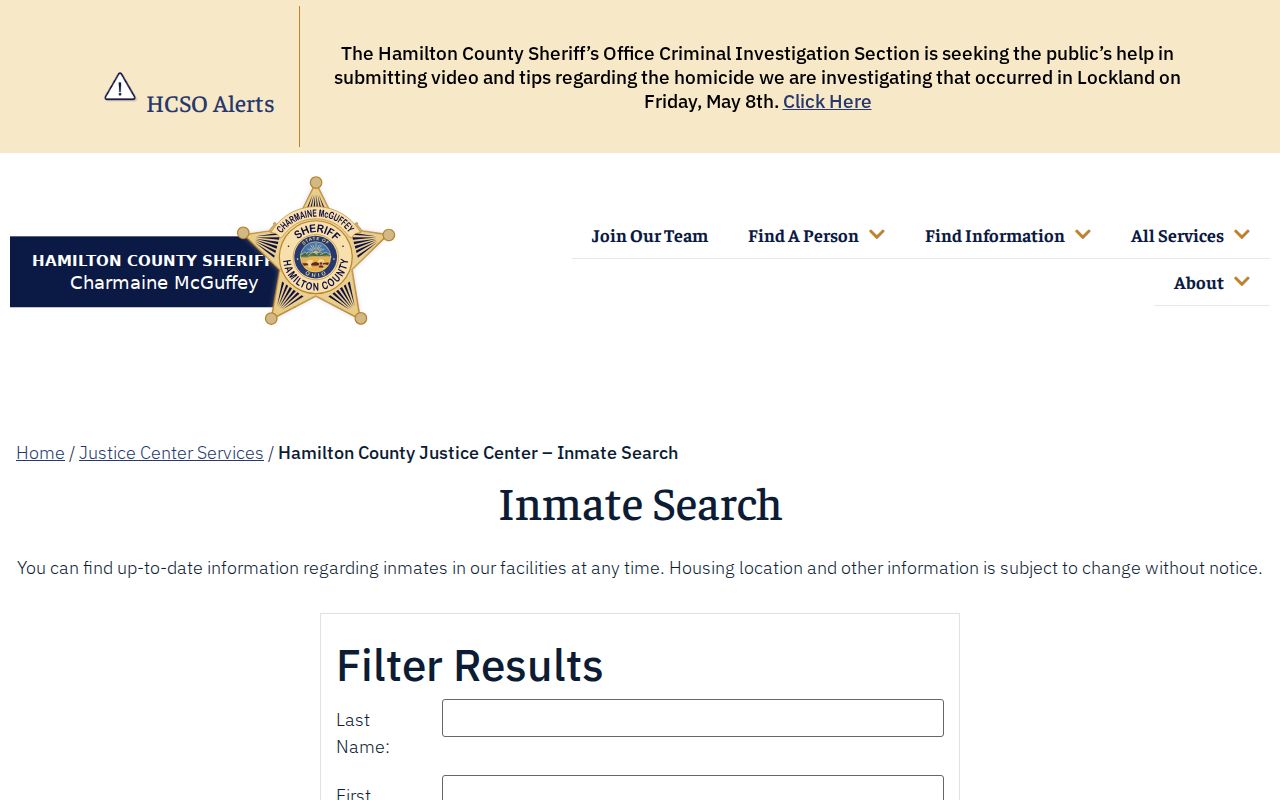
A custody result is time-sensitive and is not a general neighbor-finding tool.
Neighbors - Sheriff public records requests is the local request channel for a defined report or record.
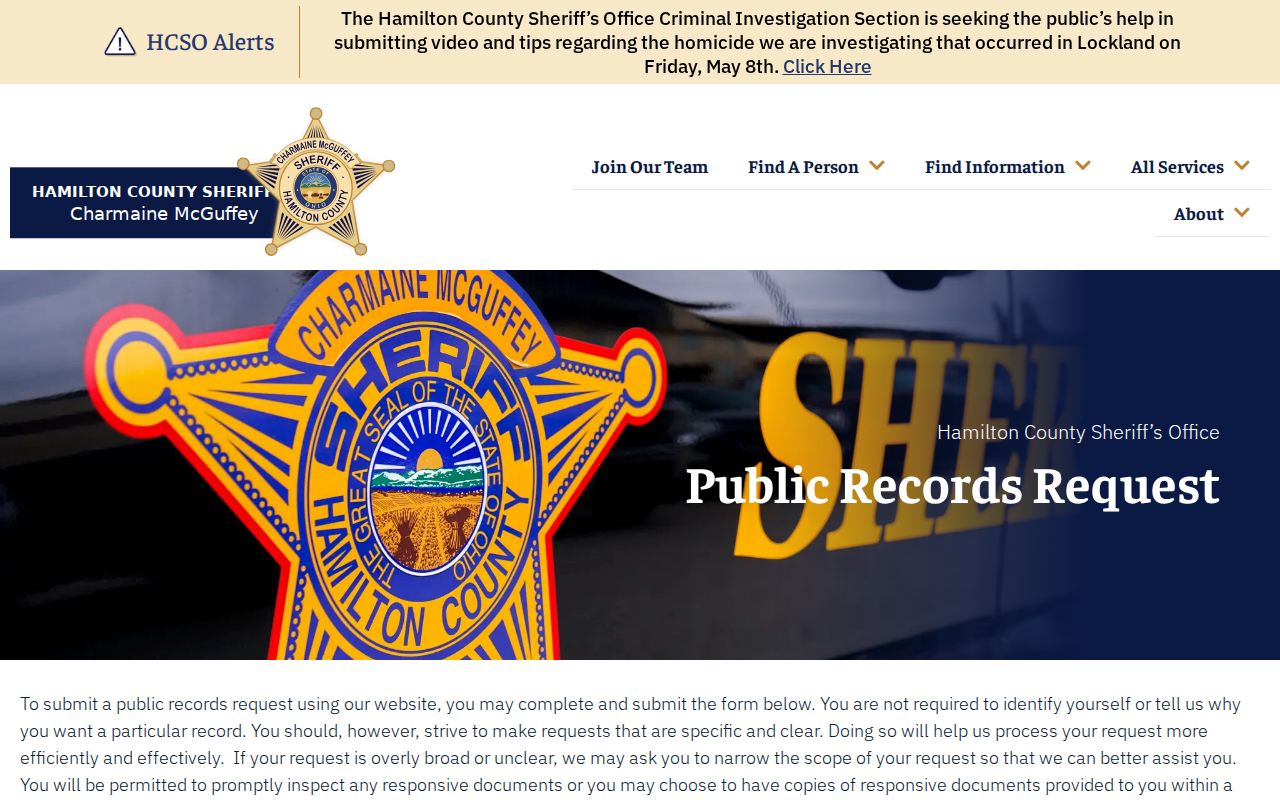
Give the incident date, location, agency, report number when known, and a clear record description, while expecting lawful redactions.
Neighbors - FTC fraud reporting is a reporting route for suspected fraud.
Preserve the message and contact the actual custodian or agency through a published number before sending money or personal information.
Anderson Township contracts for policing with the Hamilton County Sheriff’s Office, so a report, custody question, or Sheriff record request belongs with the Sheriff or County records unit, not an assumed Township police database. The Sheriff’s public-records route can use an incident date, location, report number, and agency to narrow a request. A result may be redacted for protected information or unavailable because records are sealed or otherwise exempt. For a non-law-enforcement neighborhood question, return to the Auditor, Recorder, CHPL, or Township department that actually holds the requested record.